- Dwelling On It
- Posts
- A Decade of Certainty or a Decade of Risk? The Social and Affordable Homes Programme
A Decade of Certainty or a Decade of Risk? The Social and Affordable Homes Programme
A ten-year funding commitment could reshape affordable housing delivery. But certainty in policy does not always translate into certainty on the ground.

Hussein Ali
March 17, 2026
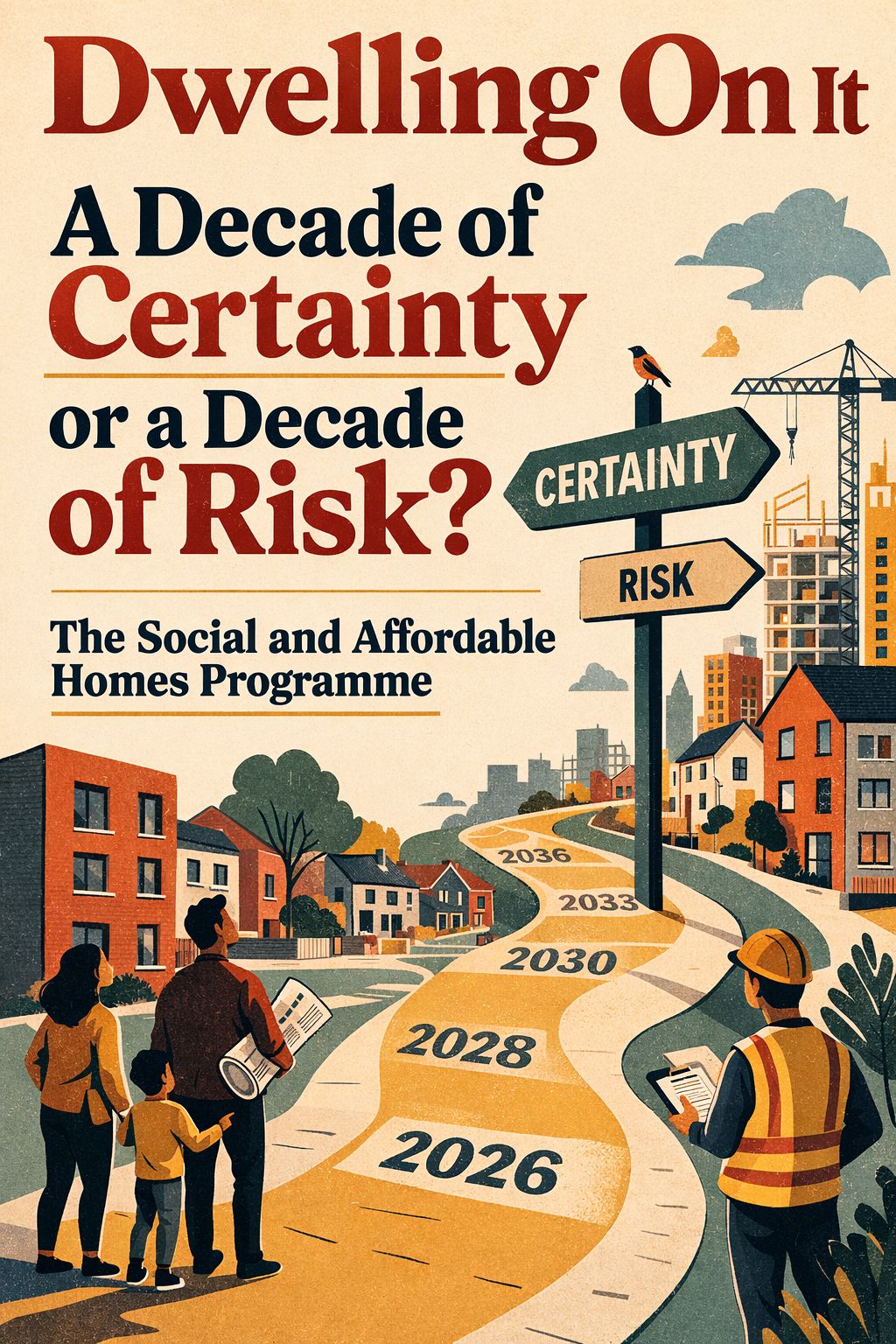
A Decade of Certainty. Or a Decade of Risk.
/
The Social and Affordable Homes Programme promises something the housing sector has wanted for a long time: ten years of capital certainty. That framing is politically useful, but it is also worth pausing on.
Some funding announcements pass by with little impact. Others signal something bigger. The launch of the Social and Affordable Homes Programme 2026–2036 clearly falls into the second category. At least £39 billion has been committed across Homes England and the Greater London Authority. Sixty per cent of homes funded are expected to be Social Rent, and bidding is already open. In scale alone, this is one of the most significant affordable housing programmes for a generation.
The government’s message is simple. Providers now have the certainty needed to plan long-term development pipelines. There is truth in that. But long programmes do not remove risk. They change where it sits.
What the Programme Actually Does
The programme works through two routes. The first is Strategic Partnerships, where larger providers can bid for programme-level funding across multiple years. New partnerships are initially capped at £250 million and are expected to deliver between 800 and 1,500 homes by March 2036 depending on the delivery route.
Alongside this sits Continuous Market Engagement. This route funds schemes individually and remains open throughout the life of the programme. It provides a pathway for smaller providers, local authorities and specialist organisations.
The numbers are ambitious. Around 300,000 affordable homes across the programme, with at least 180,000 of those expected to be delivered at Social Rent. Strategic Partnership bids close on 15 April 2026, leaving a six-week window for decisions that could shape development pipelines for the next decade.
The most important difference from previous funding rounds is the time horizon. A ten-year programme allows providers to plan regeneration properly, assemble land pipelines and build development strategies without constantly wondering whether the next funding round will exist. These are genuine advantages, but they also introduce long-term exposure.
Construction Costs Are Still the Big Unknown
The financial assumptions made in a Strategic Partnership bid submitted in 2026 will be tested repeatedly over the next decade. Construction inflation has been volatile since 2021, and the pressures that drove it have not disappeared.
Labour shortages continue to affect the sector. Material costs and energy prices remain unpredictable. Contractor insolvency is still a real risk in an industry that often operates on thin margins.
The Regulator of Social Housing highlighted many of these pressures in its 2025 Sector Risk Profile. Supply chain disruption, cost inflation and labour constraints remain among the core risks boards are expected to manage.
At the same time, financial pressure is building elsewhere in the sector. Development expenditure has edged down slightly in recent years, while maintenance spending continues to climb as stock ages and compliance expectations increase. Providers committing to ten-year development pipelines are therefore doing so in a cost environment that still feels uncertain.
Grant can absorb some pressure, but when viability assumptions move significantly it is providers who carry the impact.
The Political Timeline Is Much Shorter
There is another tension built into the programme that deserves more attention. The government has committed £39 billion across ten years, but a general election must take place no later than May 2029, only three years into the programme. Another election will fall before the programme reaches its end.
In other words, the political environment supporting the programme could change during its lifetime. That possibility is not abstract. The previous Affordable Homes Programme experienced funding adjustments and delivery challenges as economic conditions shifted.
The SAHP documentation itself hints at this uncertainty. Grant payments beyond March 2036 are described as being subject to budget availability. That wording matters. Providers delivering schemes completing after that point are working on the assumption that future funding will still be there.
Certainty to 2036 does not necessarily mean certainty beyond it.
Debt Is Where the Pressure Really Sits
The financial backdrop across the sector makes these questions more significant. Housing association borrowing passed £100 billion for the first time in 2024, and by mid-2025 providers had drawn more than £105 billion from existing facilities.
Most of that debt is fixed for several years, which provides some stability. However, some providers face refinancing at interest rates far higher than those assumed when earlier business plans were written.
That is the environment in which providers are now being asked to commit to decade-long development pipelines. Strategic Partnerships require organisations to demonstrate delivery confidence at scale, and that confidence must sit inside business plans that remain viable through uncertain interest rates, rising maintenance obligations and tightening regulatory expectations.
The Regulator of Social Housing will be watching closely. Recent governance downgrades across the sector show that regulatory scrutiny has not softened.
Why Providers Will Still Engage
None of this should be read as a reason to step back from the programme. The demand for Social Rent homes is real and urgent, and the SAHP represents the most serious attempt in more than a decade to respond to that need. The sixty per cent Social Rent target signals a clear policy priority backed by meaningful capital.
For providers with strong balance sheets and disciplined governance, the programme offers something the sector has lacked for years: a longer runway for development.
The Continuous Market Engagement route is also important. Its flexibility means delivery is not limited to the largest housing associations. Local authorities, community land trusts and specialist providers all have a pathway to participate.
There are also signs that lessons from previous programmes have been taken seriously. Portfolio CME bids create more flexibility for pipeline planning, and regeneration schemes can demonstrate additionality across portfolios rather than site by site, which better reflects how estate renewal actually works.
Certainty Is Also a Political Idea
The programme rests on a simple argument: that uncertainty has constrained development and that long-term capital stability will unlock supply. There is truth in that. Providers have spent years adjusting development programmes in response to unstable funding cycles.
But certainty itself is not fixed. It is a political claim made at a particular moment.
What the SAHP provides is certainty at launch, built on a set of economic and political assumptions that will be tested over the next decade. Boards entering Strategic Partnerships are not buying certainty. They are accepting the responsibility of managing long-term risk in exchange for access to capital.
That is not a reason to hesitate. It is a reason to stress-test assumptions carefully, plan for more than one future and ensure governance frameworks are strong enough to carry the weight of a ten-year commitment.
The homes the country needs are real. The programme designed to deliver them is real too. So are the risks. And the providers still delivering homes in 2035 will almost certainly be the ones who understood both from the beginning.Articles to Dwell On